Search Engine Optimization
SEO Fundamentals: Everything You Need to Know to Improve Organic Traffic
Search Engine Optimization (SEO) can feel like a moving target. Algorithms change, design patterns evolve, and user behaviors shift. However, the core principle remains unchanged: making your content accessible, understandable, and valuable to both human readers and search engine crawlers.
1. What Is SEO?
Search Engine Optimization (SEO) is the practice of improving a website so that search engines can better discover, understand, index, and rank its content, helping it attract more relevant organic (unpaid) traffic from search engines such as Google, Bing, and DuckDuckGo.
When someone enters a query or keyword into a search engine, the search engine evaluates and ranks relevant pages from its index based on many factors, including content relevance, quality, authority, technical accessibility, and user experience. Effective SEO helps your website become more visible in these organic search results, increasing the likelihood that the right users will discover and visit your site.
SEO is not simply about getting a page to rank higher. It is about building a website that is accessible to search engines, useful to users, technically sound, and relevant to what people are searching for.
Organic Traffic vs. Paid Traffic
Search traffic generally comes from two major sources: organic search and paid search.
-
Organic Traffic: Visitors who discover your website through unpaid search results. Organic visibility is earned through factors such as useful content, strong technical SEO, relevant search intent, internal linking, and website authority. It typically takes time to build, but successful SEO can continue generating traffic without paying for every click.
-
Paid Traffic (PPC / Search Ads): Visitors who arrive through paid advertisements displayed on search engine results pages. Paid search can provide immediate visibility and predictable placement, but the traffic generated by the campaign generally stops when the advertising budget or campaign ends.
2. How Search Engines Work
To have a better SEO, you must understand the underlying mechanics of search engine architecture. Search engines do not search the live web in real time when a user enters a query; instead, they search an updated, indexed copy of the web that they have gathered in advance.
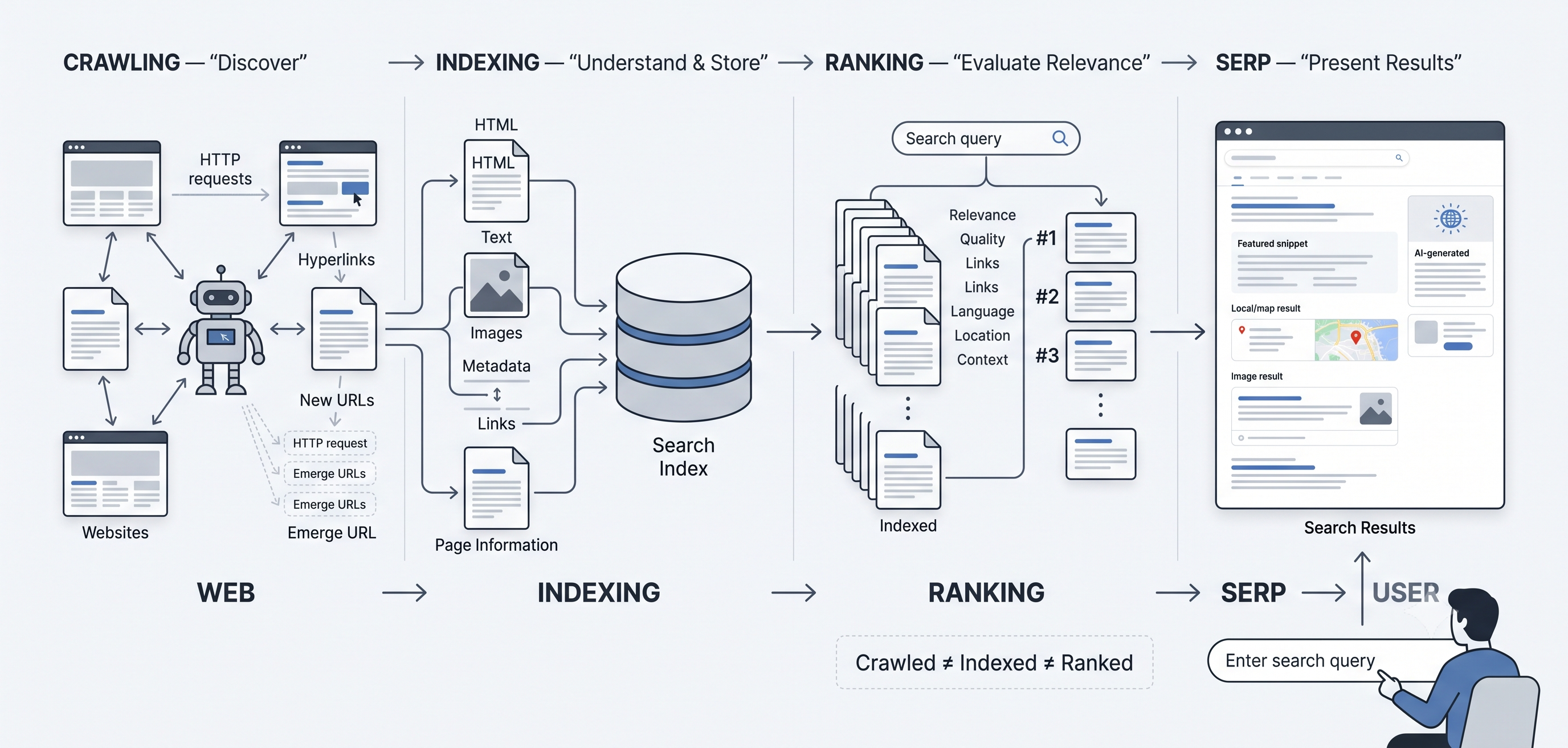
This process operates through a continuous four-stage pipeline: Crawling, Indexing, Ranking, and Displaying SERPs.
2.1 Crawling
Crawling is the automated discovery phase. Search engines deploy continuous software programs known as spiders, bots, or web crawlers (such as Googlebot) to scan and discover web pages across the internet.
How Crawling Operates
- The URL Frontier: Crawlers begin with an extensive list of known web addresses gathered from prior crawls and user submitted sitemaps.
- Link Following: As Googlebot fetches a page, it parses the HTML and extracts hyperlinks (
<a href="...">). These new URLs are added to the queue for future crawling. - Crawl Budget Optimization: Google does not crawl every page on every site equally. It allocates a Crawl Budget (a combination of crawl demand and crawl rate limit) based on:
- Site Popularity & Authority: Frequently updated and highly linked sites get crawled more often.
- Server Capacity: If your server responds slowly or throws 5xx errors, Google slows down its crawl rate to prevent crashing your site.
Key takeaway for SEOs: If a search crawler cannot reach a page due to broken internal links, poor site architecture, or restrictive server responses, that page cannot exist in search results no matter how high its content quality is.
2.2 Indexing
Once a page is discovered and fetched during the crawling stage, it moves to the Indexing stage. Indexing is the process of analyzing, parsing, and storing a web page's content inside Google's massive global database the Search Index (e.g., Google’s Caffeine database).
What Happens During Indexing?
- DOM Rendering: Modern crawlers don't just read raw HTML; they execute JavaScript and render the full Document Object Model (DOM) to view the page as a human user would.
- Content Extraction: The indexer extracts textual content, headings, images, video data, structured data (Schema markup), and link metadata.
- Canonicalization: If identical or near-duplicate pages exist (e.g., HTTP vs. HTTPS, or URL parameters like
?sort=price), the indexer determines the main "canonical" version and groups the others behind it. - Quality & Rule Evaluation: The indexer checks for
noindexdirectives, low-quality content, thin text, or security flags. Pages meeting Google’s webmaster guidelines are stored in the index.
Raw Page Fetch ──> JavaScript Rendering ──> Content Parsing ──> Canonical Check ──> Saved to Search Index
2.3 Ranking
Ranking occurs instantly when a user submits a search query. The search engine queries its index to pull the most relevant, reliable answers and orders them using algorithmic scoring mechanisms.
Google uses thousands of signals processed by machine learning systems like RankBrain and MUM to score pages across several primary categories:
| Ranking Category | Key Signals & Factors | Why It Matters |
|---|---|---|
| Relevance | Keyword match in title tags, body text, headings, and overall semantic coverage. | Proves the content directly answers the user's explicit search request. |
| Authority | Inbound backlink quantity, link domain diversity, and PageRank flow. | Indicates that other reputable web properties trust and reference your content. |
| Experience (E-E-A-T) | Demonstrated first-hand experience, author transparency, editorial citations, and brand reputation. | Ensures searchers receive accurate, safe, and trustworthy information. |
| User Experience & Speed | Core Web Vitals (LCP, INP, CLS), HTTPS encryption, and mobile usability. | Prevents users from abandoning pages due to lag, layout shifts, or bad design. |
| Context & Personalization | Searcher location, device type, search history, and language preferences. | Tailors results (e.g., searching "pizza" in Tokyo vs. Chicago returns different local results). |
2.4 Search Engine Results Pages (SERPs)
The Search Engine Results Page (SERP) is the interface presented to the user after entering a query. Modern SERPs have evolved far beyond the classic list of 10 organic "blue links." They are dynamic, media-rich layouts engineered to satisfy user intent as quickly as possible.
Key SERP Feature Components
- Featured Snippets (Position 0): High-visibility blocks at the top of organic results that extract a direct definition, table, or ordered list from a web page to answer specific informational queries.
- AI Overviews: AI-generated synthetic summaries positioned at the top of the SERP that aggregate key insights across multiple web sources.
- People Also Ask (PAA): Interactive accordion widgets displaying related follow-up questions and concise source answers.
- Local Pack (Map Pack): A localized map showing 3 top business locations with ratings, addresses, and hours, triggered by queries with local intent (e.g., "plumber near me").
- Rich Snippets: Enhanced organic listings containing extra metadata like star ratings, review counts, recipe prep times, or product availability derived from Schema markup.
- Knowledge Panels: Informational boxes appearing on the right side of desktop results that summarize consolidated knowledge about entities (brands, public figures, places).
3. The Three Pillars of SEO
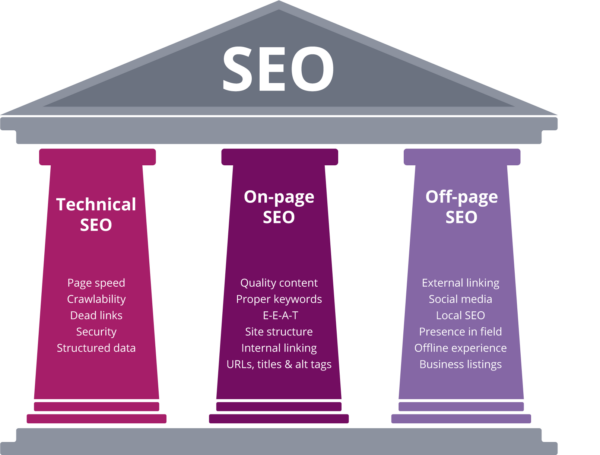
Modern Search Engine Optimization is not a single discipline, but an interconnected ecosystem resting on three foundational pillars: Technical SEO, On-Page SEO, and Off-Page SEO.
Treating these pillars as isolated tasks leads to diminished returns. A site with world-class content will fail if technical errors block indexation, while a technically flawless site will stagnate without authority signals from the web. Sustainable organic growth requires a synchronized execution across all three areas.x`
3.1 Technical SEO
Technical SEO is the digital foundation. It ensures search engine crawlers can efficiently discover, parse, render, and index your website's pages without friction. If search engines cannot crawl or render your content properly, no amount of keyword optimization or backlink building will deliver results.
Strategic Focus Areas
-
Crawlability & Indexability: Managing crawl budgets via
robots.txt, XML sitemaps, and HTTP status codes. Resolving indexation blockers, canonicalization loops, and faceted navigation bloat. -
Architecture & Rendering: Optimizing site hierarchy and handling Client-Side Rendering (CSR) versus Server-Side Rendering (SSR) for JavaScript-heavy frameworks (React, Next.js, Vue).
-
Core Web Vitals & Page Experience: Optimizing performance metrics that directly influence user satisfaction and ranking algorithms:
-
Largest Contentful Paint (LCP): Loading performance (target: < 2.5s).
-
Interaction to Next Paint (INP): Visual responsiveness to user input (target: < 200ms).
-
Cumulative Layout Shift (CLS): Visual stability during loading (target: < 0.1s).
-
Structured Data & Schema: Implementing JSON-LD structured data to help search engines understand page context, entities, and relationships enabling Rich Snippets in Search Engine Results Pages (SERPs).
Strategic Takeaway: Technical SEO does not directly rank content; rather, it removes the ceiling that prevents high-quality content from ranking to its full potential.
3.2 On-Page SEO
On-Page SEO aligns your website's content and structure with user intent and algorithmic expectations. It focuses on demonstrating E-E-A-T (Experience, Expertise, Authoritativeness, and Trustworthiness) while fulfilling the specific needs of searchers.
Strategic Focus Areas
- Search Intent & Keyword Mapping: Categorizing queries into informational, commercial, transactional, or navigational intent. Mapping primary and secondary entities to dedicated content assets rather than stuffing exact-match keywords.
- Topical Authority & Content Hubs: Structuring content around "Pillar Pages" and interconnected "Cluster Content" to demonstrate comprehensive subject-matter depth to search crawlers.
- Semantic & Entity-Based Optimization: Leveraging Natural Language Processing (NLP) tools to optimize for related entities, concepts, and semantic context ensuring content comprehensively answers the user's underlying problem.
- On-Page UX & Information Architecture: Optimizing title tags, meta descriptions, header hierarchies (
H1–H4), internal link anchor text, and visual media to lower bounce rates and improve engagement depth.
Strategic Takeaway: Modern On-Page SEO is no longer about repeating keywords; it is about providing the most authoritative, complete, and user-friendly answer to a searcher's query.
3.3 Off-Page SEO
Off-Page SEO establishes your domain’s credibility, authority, and market standing within the wider web ecosystem. Search engines treat external validation, primarily backlink profiles and digital mentions as votes of confidence in your site's reliability.
Strategic Focus Areas
- High-Impact Link Acquisition: Earning contextual, non-paid backlinks from authoritative domains within your industry niche via Digital PR, proprietary research, and data-driven assets.
- Entity & Brand Building: Cultivating unlinked brand mentions, executive thought leadership, and consistent NAP (Name, Address, Phone) citations to solidify brand entities in Google’s Knowledge Graph.
- Digital PR & Outreach: Generating media coverage through trend-jacking, expert commentary, and targeted outreach to journalists and industry publications.
- Toxic Link Mitigation: Monitoring incoming link profiles for negative SEO attacks, spam network footprinting, and applying disavow strategies when algorithmic flags threaten domain health.
Strategic Takeaway: Off-Page SEO is not a volume game. A single contextual link from an authoritative, trusted industry publication carries more algorithmic weight than hundreds of low-tier directory links.
4. Keyword Research & Search Intent
Keyword research isn't just about collecting phrases; it’s about mapping user demand. It is the practice of identifying the exact language your target audience uses when searching for answers, solutions, or products. It's allowing you to align your site’s architecture and content directly with real-world demand.
4.1 Keywords
Search queries are generally classified by their specificity, volume, and positioning within the buyer journey:
| Category | Typical Length | Search Volume | Competition | Conversion Intent | Example Query |
|---|---|---|---|---|---|
| Short-Tail (Head Terms) | 1–2 words | High | Extreme | Broad / Vague | "Coffee" |
| Middle-Tail | 2–3 words | Moderate | Moderate–High | Research / Consideration | "Best cold brew maker" |
| Long-Tail | 3+ words | Low–Moderate | Low–Moderate | High / Specific | "Best organic cold brew maker for small kitchens" |
4.2 Strategic Deployment
A balanced SEO campaign rarely relies on just one keyword type. Instead, your strategy should match your domain's authority and business goals:
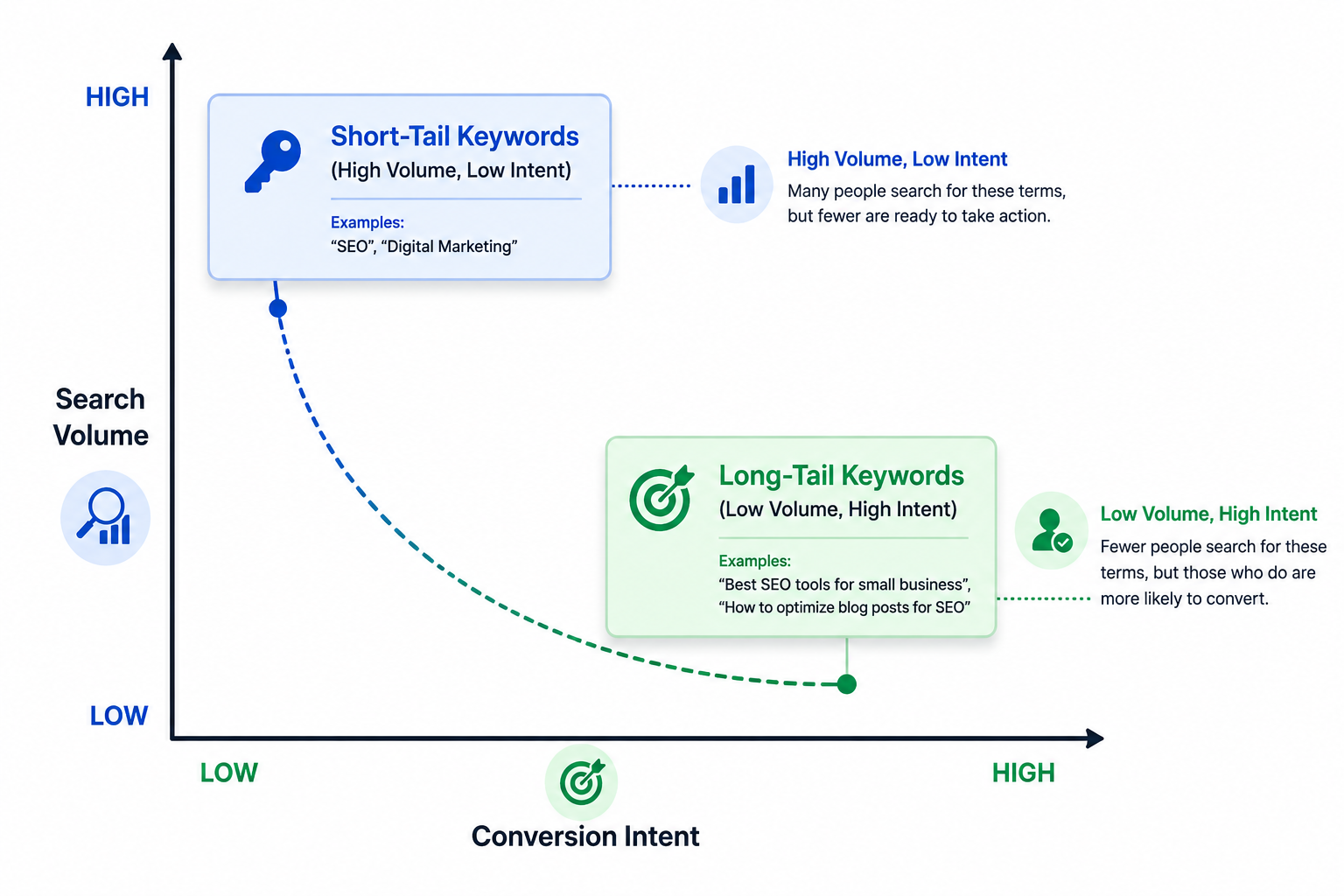
- Short-tail keywords build brand exposure and drive top-of-funnel traffic. However, ranking for head terms requires massive authority, high backlink volume, and significant patience. The trade-off is low conversion rates due to mixed user intent.
- Long-tail keywords form the backbone of sustainable organic growth, especially for newer or lower-authority domains. While individual search volumes are lower, long-tail terms account for roughly 70% of all search queries. They capture users who know precisely what they want, leading to higher click-through rates (CTR) and faster conversion paths.
4.3 Search Intent
Google’s core algorithm prioritizes satisfying user intent above keyword density or exact-match phrasing. To rank, your content format must align with what searchers expect to find:
-
Informational: The user wants to learn or troubleshoot.
-
Example: "How does a turbocharger work?"
-
Content Type: Comprehensive guides, tutorials, or explainer videos.
-
Navigational: The user is trying to reach a specific destination.
-
Example: "Shopify merchant login"
-
Content Type: Dedicated landing pages, branded portals, or clear site architecture.
-
Commercial Investigation: The user is evaluating options before making a decision.
-
Example: "iPhone 15 Pro vs Samsung S24 Ultra"
-
Content Type: Comparison tables, buyer guides, feature teardowns, and user reviews.
-
Transactional: The user is primed to complete an action or purchase.
-
Example: "Buy Nike Pegasus running shoes size 10"
-
Content Type: E-commerce product pages, pricing grids, and checkout paths.
4.4 Keyword Cannibalization
Keyword cannibalization occurs when multiple pages on your domain inadvertently target the exact same query and search intent.
When pages compete against themselves, you dilute internal link equity, split user engagement signals, and confuse search algorithms about which URL is the primary authority. This usually results in volatile rankings, with pages swapping positions before dropping out of top results entirely.
How to spot and fix cannibalization:
- Audit: Run a
site:yourdomain.com "keyword"search or check Google Search Console for multiple URLs ranking for identical queries with low average positions. - Consolidate: Merge thin or overlapping pages into one master resource.
- Redirect: Implement 301 redirects from obsolete secondary pages to the main resource.
- Re-optimize: Shift distinct pages toward secondary, unique long-tail variations if both pieces of content serve genuinely different sub-topics.
5. On-Page SEO
On-page SEO goes beyond mere keyword placement. It is the process of structuring HTML elements, content depth, and internal links so that search engines can accurately interpret context while users receive a frictionless experience.
5.1 Title Tags
The title tag (<title>) remains one of the strongest on-page contextual signals. It forms the clickable headline in search results and directly influences both rankings and click-through rates (CTR).
- Length & Truncation: Target 50–60 characters (or under 580 pixels). Excessively long titles are truncated with ellipses (
...) by Google, or rewritten entirely. - Front-Loading: Place your primary keyword near the beginning where it carries the most weight, followed by secondary modifiers or your brand name.
- Pattern:
Primary Keyword - Secondary/Modifier | Brand Name - Example:
On-Page SEO Checklist: 10-Step Optimization Guide | Search Engine Journal
5.2 Meta Descriptions
While Google explicitly does not use meta descriptions as a direct ranking signal, they serve as your organic ad copy. A compelling description drives clicks, improving your CTR and sending positive user-engagement signals back to search engines.
- Length: Keep descriptions between 140–155 characters on desktop and roughly 120 characters on mobile to avoid truncation.
- Conversion Focus: Match the user’s intent directly, weave in secondary long-tail keywords naturally, and end with a clear action prompt (e.g., "Learn how to optimize your pages today").
- Reality Check: Google rewrites meta descriptions roughly 60–70% of the time depending on the query. Writing clear, highly relevant summaries minimizes the chance of Google overriding your copy.
5.3 Headings (H1, H2, H3)
Headings provide logical scaffolding for human readers and tell search crawlers how subtopics relate to the broader page topic.
- Single
H1Rule: Use exactly oneH1per page, matching the core topic or article title. - Strict Logical Hierarchy: Do not jump from an
H1directly to anH3for visual styling—use CSS for styling and HTML tags exclusively for structure. - Search Context: Include target keywords and semantic variants in your
H2andH3tags naturally. These headings are frequently pulled directly into Google’s Featured Snippets.
<h1> Ultimate Guide to On-Page SEO (Main Topic)
 ├── <h2> 1. Title Tag Optimization (Major Subtopic)
 │    ├── <h3> Character Limits & Truncation (Detail)
 │    └── <h3> Keyword Front-Loading (Detail)
 └── <h2> 2. Heading Structure (Major Subtopic)
5.4 URL Structure
Clean, predictable URLs help search engines map site architecture and give users confidence before clicking.
- Descriptive & Hyphenated: Use lowercase words separated by hyphens (
-). Avoid underscores (_) or dynamic parameters (?id=123). - Brevity & Depth: Keep URLs concise and reasonably flat. Omit stop words (a, the, in, and) unless they alter the meaning.
- Examples:
- Optimized:
example.com/blog/on-page-seo-guide - Poor:
example.com/category/post_123.php?ref=twitter
5.5 Content Quality & E-E-A-T
Google uses the E-E-A-T framework (Experience, Expertise, Authoritativeness, Trustworthiness) detailed in its Search Quality Rater Guidelines to evaluate content quality, particularly for "Your Money or Your Life" (YMYL) topics.
- Experience: Show proof of real-world interaction (e.g., original photos, original testing methodology, or personal case studies).
- Expertise: Credential your content. Include verified author bios, reviewer lines, and technical citations.
- Authoritativeness: Build niche reputation through consistent coverage, external citations, and industry mentions.
- Trustworthiness: Maintain transparent site information (e.g., published editorial policies, clear contact details, and secure HTTPS protocols). Trust is the central core of E-E-A-T; without it, the other three fall flat.
5.6 Internal Linking
Internal links establish information hierarchy, pass authority (PageRank) across pages, and help crawlers discover orphan content.
- Descriptive Anchor Text: Avoid generic text like "click here" or "read more." Use descriptive, keyword-rich anchor text that clearly indicates what the destination page is about (e.g., "Learn more in our complete technical SEO audit guide").
- Contextual Placement: Priority should be given to inline contextual links within the main body content rather than repetitive footer or sidebar links.
- Depth Management: Ensure critical pages sit within 3 clicks of the homepage to maximize crawl efficiency and internal authority distribution.
5.7 Images & Alt Text
Image optimization impacts page loading speed and opens up visibility within Google Image Search.
-
Alt Text: Write concise, descriptive alternative text for accessibility (screen readers) and search engines. Describe what is visually happening in the image while maintaining natural context.
-
Bad:
alt="seo search engine optimization guide link"(Keyword stuffed) -
Good:
alt="Diagram illustrating proper heading hierarchy from H1 to H3" -
Technical Performance: Compress images using modern formats (WebP or AVIF), supply explicit
widthandheightdimensions to prevent Cumulative Layout Shift (CLS), and implement lazy loading (loading="lazy") for off-screen images.
5.8 Canonical Tags (On-Page Perspective)
A canonical tag (rel="canonical") acts as a directive telling search engines which master URL should be indexed when duplicate or parameter-heavy variants of a page exist.
<!-- Place inside the <head> section of identical/similar pages -->
<link rel="canonical" href="https://example.com/primary-page/" />
- Self-Referential Canonicals: Every unique page should feature a canonical tag pointing to its own clean, definitive URL to prevent dynamic parameter tracking (e.g.,
?utm_source=...) from causing duplication. - Cross-Domain Canonicals: If you syndicate your content across multiple domains or platforms (e.g., Medium), require those platforms to include a cross-domain canonical tag pointing back to your original source article.
6. Technical SEO
Technical SEO optimizes your site’s underlying architecture, rendering pipeline, and server performance. It ensures search engine bots can efficiently discover, parse, rendering, and index your content without hitting technical bottlenecks or wasting crawl resources.
6.1 Crawlability vs. Indexability
While closely linked, crawlability and indexability represent two distinct stages in how Google processes your site:
- Crawlability: A search bot’s ability to discover and fetch URL paths across your site. Obstacles include poor site architecture, broken internal links, infinite loops, dynamic parameter traps, or misconfigured directives blocking access.
- Indexability: A search engine's willingness and permission to parse and add a crawled URL into its search index. A page can be perfectly crawlable, but unindexable due to
noindexmeta tags, canonicalization to a different URL, thin/duplicate content flags, or status code errors.
6.2 Robots.txt
The robots.txt file acts as a traffic control protocol located at your root domain (example.com/robots.txt). It manages crawler access to prevent server overload and conserve crawl budget on utility or low-value pages.
User-agent: *
Disallow: /admin/
Disallow: /cart/
Disallow: /search?*

Sitemap: https://example.com/sitemap.xml
Crucial Edge Case: A Disallow rule in robots.txt prevents crawlers from fetching the page content, but it does not prevent indexation. If an external site links to a disallowed URL, Google can still index the URL bare based on anchor text signals. To drop a page from the index entirely, allow crawling and implement a <meta name="robots" content="noindex"> tag or return a 410 status code.
6.3 XML Sitemap
An XML sitemap serves as a roadmap of your canonized, high-priority URLs, accelerating content discovery and aiding crawlers during updates.
- Inclusion Standards: Only include canonical, indexable URLs returning
200 OKresponses. Keep dynamic parameters, redirected URLs (301), soft errors (404), andnoindexpages out of your sitemaps. - Scale Limits: A single XML sitemap file cannot exceed 50,000 URLs or 50MB uncompressed. Use a Sitemap Index file to group multiple categorized XML sitemaps (e.g.,
post-sitemap.xml,product-sitemap.xml) for large-scale sites. - GSC & Ping: Submit your primary sitemap index via Google Search Console and ensure it is referenced directly inside your
robots.txtfile.
6.4 HTTP Status Codes
HTTP response codes communicate the state of a requested resource to user agents and crawlers. Proper status code hygiene prevents authority loss and waste of crawl budget.
| Status Code | Type | Technical Impact & SEO Handling |
|---|---|---|
| 200 OK | Success | Ideal state for all primary, indexable content. |
| 301 Moved Permanently | Permanent Redirect | Passes ~90–99% of PageRank equity to the target URL. Use for permanent migration or URL structure changes. |
| 302 Found | Temporary Redirect | Signals that the source URL will return soon. Google will not permanently swap indexed URLs or pass full equity right away. |
| 404 / 410 Not Found | Client Error | 404 indicates missing content (Google will retry). 410 Gone explicitly tells crawlers the deletion is permanent, hastening de-indexing. |
| 500 / 503 Error | Server Error | Indicates infrastructure failure. Persistent 500/503 responses prompt Googlebot to back off crawling and temporarily drop pages from rankings to avoid showing broken links to users. |
Avoid Redirect Chains: Ensure internal links point directly to final destination URLs. Chaining multiple redirects together (A -> B -> C) degrades page speed and can cause crawlers to abandon the path mid-way.
6.5 HTTPS
HTTPS is a explicit HTTPS encryption signal and a core prerequisite for modern web safety.
- SSL/TLS Protocol: Encrypts sessions using modern TLS standards (TLS 1.3). Ensure expired, weak, or misconfigured certificates are renewed automatically.
- Mixed Content Audit: Prevent "mixed content warnings" by verifying that all assets (scripts, stylesheets, images, and fonts) are requested over HTTPS rather than HTTP.
- HSTS Integration: Implement HTTP Strict Transport Security (HSTS) response headers to force browsers and bots to connect via secure HTTPS protocols exclusively, bypassing initial insecure HTTP requests.
6.6 Mobile SEO
Google evaluates, indexes, and ranks web pages using its mobile crawler (Googlebot Smartphone). Your mobile site is your primary site in the eyes of search algorithms.
- Parity Requirement: Ensure full content, schema markup, heading structures, internal links, and meta elements match between desktop and mobile versions. Hiding core text or links behind interactive toggles on mobile can hinder indexing.
- Responsive Architecture: Avoid separate mobile domains (e.g.,
m.example.com). Utilize responsive CSS web design using standardized viewport meta tags (<meta name="viewport" content="width=device-width, initial-scale=1">). - Core Web Vitals Performance: Mobile rendering efficiency directly affects ranking capability. Priority metrics include:
- Largest Contentful Paint (LCP): Main content render time (target: < 2.5s).
- Interaction to Next Paint (INP): Visual responsiveness after user action (target: < 200ms).
- Cumulative Layout Shift (CLS): Visual element stability during load (target: < 0.1).
7. Website Performance & Core Web Vitals
Google incorporates Core Web Vitals (CWV) into its Page Experience signals, quantifying real-world user experience through field metrics collected via the Chrome User Experience Report (CrUX). Optimizing these metrics ensures higher engagement, reduces bounce rates, and serves as a direct ranking factor for organic search performance.
| Metric | Focus Area | Good Target | Technical Mechanism | Common Causes & Remediation |
|---|---|---|---|---|
| LCP Largest Contentful Paint | Loading Speed | ≤ 2.5 sec | Measures the time required to render the single largest visible text block, image, or video hero element within the viewport. | Issues: Slow server response times, render-blocking JavaScript/CSS, lazy-loading above-the-fold images. Fixes: Implement CDN edge caching, pre-connect critical origins, optimize image formats (AVIF/WebP), and add fetchpriority="high" to hero assets. |
| INP Interaction to Next Paint | Interactivity & Latency | ≤ 200 ms | Evaluates long-term page responsiveness by measuring the latency of user taps, clicks, or keypresses throughout the page visit. | Issues: Heavy main-thread execution, long-running JavaScript tasks, unoptimized event handlers. Fixes: Break up long tasks (>50ms) using requestIdleCallback() or yield(), defer non-essential scripts, and reduce third-party script overhead. |
| CLS Cumulative Layout Shift | Visual Stability | ≤ 0.1 | Quantifies the total sum of unexpected visual layout shifts that occur as fonts, images, ads, or dynamic elements are injected without reserved space. | Issues: Images/embeds lacking explicit dimensions, web fonts loading late (FOUT/FOIT), dynamically injected DOM elements. Fixes: Declare explicit width and height attributes on media, preload key web fonts, and reserve static CSS dimensions for dynamic banners/ads. |
8. Structured Data & Schema Markup
Structured data is a standardized machine-readable annotation format that translates unstructured web page content into explicit semantic metadata. By declaring entities, relationships, and attributes using the Schema.org vocabulary, you give search crawlers precise context about your content's true intent.
8.1 Rich Results & Search Visibility
Implementing Schema markup does not directly boost organic rankings, but it directly impacts search visibility and user interaction:
- Enhanced SERP Footprint: Unlocks Rich Results (such as review stars, recipe details, event schedules, price ranges, and article metadata) that significantly expand your visual real estate on SERPs.
- Higher Click-Through Rates (CTR): Rich results improve visual contrast and provide pre-click context, leading to higher intent traffic and higher CTRs.
- Entity Relationship Building: Explicitly links your content to defined entities in Google’s Knowledge Graph, supporting E-E-A-T signals and context mapping across subtopics.
8.2 JSON-LD Syntax Standard
While Schema can be implemented via Microdata or RDFa inline attributes, Google officially recommends JSON-LD (JavaScript Object Notation for Linked Data). JSON-LD sits within a distinct <script> block in the HTML <head> or <body>, completely decoupled from your page layout and styling.
<script type="application/ld+json">
{
  "@context": "https://schema.org",
  "@type": "Article",
  "mainEntityOfPage": {
    "@type": "WebPage",
    "@id": "https://example.com/seo-guide"
  },
  "headline": "The Ultimate Guide to Technical and On-Page SEO",
  "description": "An end-to-end framework for optimizing page performance, crawling efficiency, and search intent.",
  "image": "https://example.com/images/seo-guide-hero.jpg",
  "author": {
    "@type": "Person",
    "name": "Alex Mercer",
    "jobTitle": "Lead SEO Strategist",
    "sameAs": "https://www.linkedin.com/in/alexmercer-seo"
  },
  "publisher": {
    "@type": "Organization",
    "name": "Search Insights",
    "logo": {
      "@type": "ImageObject",
      "url": "https://example.com/logo.png"
    }
  },
  "datePublished": "2026-03-15T08:00:00+00:00",
  "dateModified": "2026-07-20T10:30:00+00:00"
}
</script>
8.3 Core Schema Types to Deploy
Depending on your site structure, prioritize high-value schema types:
Organization/LocalBusiness: Defines brand identity, logos, contact methods, physical addresses, and social profile links (sameAs).Article/BlogPosting: Establishes author credentials, publication dates, and publisher metadata for news and editorial content.Product&Offer: Injects price points, live stock availability, product ratings, and SKU numbers for e-commerce catalog items.FAQPage/HowTo: Formats step-by-step procedures and question-answer pairs directly inside search listings.BreadcrumbList: Clarifies internal site hierarchy in search result URL previews.
8.4 Testing & Maintenance Workflow
Deploying invalid structured data can result in manual action penalties or simple display failure on SERPs:
- Validation: Use the Schema Markup Validator (Schema.org) to verify syntax accuracy and the Rich Results Test (Google) to confirm eligibility for rich features.
- Monitoring: Audit structured data health inside Google Search Console’s Enhancements reports to identify missing required properties or parsing warnings at scale.
- No Manipulation: Ensure all structured data reflects content directly visible to human visitors. Annotating hidden content or misleading information violates Google’s Search Essentials policies.
9. Off-Page SEO
Off-page SEO encompasses all optimization activities conducted outside of your immediate domain. While on-page and technical SEO establish your site’s baseline quality and structure, off-page factors serve as external validation signaling your site's authority, reputation, and trustworthiness across the broader web ecosystem.
9.1 Backlinks & Authority Transfer
A backlink is an external hyperlink from a third-party domain pointing to your page. Search engines view backlinks as external endorsements, transferring algorithmic equity (historically known as PageRank) to your site.
Backlink Quality Framework
- Authority & Trust: A single link from a established, high-authority domain (e.g., nytimes.com or an accredited academic institution) holds significantly more value than hundreds of low-quality, spammy directory listings.
- Niche Relevance: Context matters. A link from a smaller, specialized industry blog carries far more topical weight than a link from an unrelated high-traffic viral news aggregator.
- Anchor Text Context: Descriptive, naturally integrated anchor text reinforces topic relevance for the destination page. Over-optimized, exact-match keyword anchor text can trigger algorithmic spam filters.
Link Rel Attributes
Search engines use rel attribute tags on <a> HTML elements to determine how authority is handled:
| Attribute | Technical Purpose & Equity Behavior |
|---|---|
dofollow (Standard) | Default link state. Explicitly passes PageRank equity and topical context to the target URL. |
rel="nofollow" | Hints to search crawlers not to associate your site with, or transfer PageRank equity to, the destination page. |
rel="sponsored" | Specifically designates links created via paid agreements, sponsorships, affiliate tracking, or advertisements. |
rel="ugc" | Applied to user-generated content, such as forum discussions, user reviews, or blog comment sections. |
9.2 Digital PR, Brand Signals & Entity Building
Modern off-page SEO extends far beyond manual link outreach. Google’s algorithms evaluate your brand as an "entity" in its Knowledge Graph, using web-wide signals to gauge your industry standing:
- Unlinked Brand Mentions: Search engines aggregate unlinked mentions of your company, product names, or key personnel across authoritative news outlets. These citations contribute to entity association and brand sentiment tracking.
- Data-Driven Digital PR: Earning natural editorial coverage requires providing genuine value. High-impact tactics include publishing proprietary data studies, conducting industry surveys, creating interactive tools, and offering expert commentary to press outlets.
- E-E-A-T Co-citations: When your brand or authors are cited alongside established niche authorities, it reinforces your domain’s Subject Matter Expertise and overall Trustworthiness within Google's evaluation algorithms.
10. Google Search Console (GSC)
Google Search Console is a free tool provided by Google that lets you monitor, maintain, and troubleshoot your site's presence in Google Search results.
Core GSC Modules:
- Indexing Report: Identifies which pages are successfully indexed and flags errors (e.g.,
404,noindexblocks, server errors). - Search Performance: Displays impressions, clicks, average CTR, and top ranking keywords.
- Core Web Vitals: Highlights field performance data for mobile and desktop users.
- URL Inspection Tool: Test how Google crawls and renders a specific URL in real time.
11. Common SEO Mistakes to Avoid
Avoid these common mistakes that can hurt rankings, visibility, and user experience:
- Keyword Stuffing: Repeating keywords unnaturally instead of writing naturally for users.
- Ignoring Search Intent: Creating content that does not actually satisfy what users are searching for.
- Duplicate Content: Publishing substantially similar pages without proper canonicalization or URL handling.
- Buying or Manipulating Backlinks: Using link schemes that can violate Google's spam policies.
- Poor Mobile Experience: Ignoring responsive layouts, navigation, readability, or mobile usability.
- Indexing Issues: Accidentally blocking important pages with
robots.txt,noindex, incorrect canonicals, or broken redirects. - Slow Performance: Neglecting Core Web Vitals, large images, excessive JavaScript, and other performance problems.
- Thin Content: Publishing low-value pages that provide little unique or useful information.
- Weak Internal Linking: Leaving important pages difficult for users and search engines to discover.
12. SEO in the AI Search Era
Search is evolving beyond traditional blue links. Google’s AI Overviews, ChatGPT, Perplexity, and Gemini are changing how people discover information, compare options, and find answers.
SEO still matters, but visibility increasingly depends on being a clear, credible, and useful source of information.
Key Strategies for AI-Era Optimization
-
Optimize for Direct Answers: Structure content clearly with concise explanations, descriptive headings, lists, and tables. Make important information easy for both users and search systems to understand and summarize.
-
Build Entity Authority: Clearly establish who you are, what your website represents, and what topics you specialize in. Consistent information across your website, structured data, and reputable third-party sources can strengthen your overall authority.
-
Publish First-Hand Experience: Original research, experiments, case studies, benchmarks, and real-world insights are harder to replicate than generic information. Share what you have actually tested, built, measured, or learned.
-
Prioritize Trust and Accuracy: AI systems need reliable sources to reference. Keep important information accurate, cite credible sources where appropriate, and demonstrate expertise through evidence rather than simply making claims.
The goal is no longer just to rank first. It is to become a source that search engines and AI systems can confidently understand, trust, and reference.
13. Final Thoughts
SEO is not a one-time task, But it is an ongoing process of improving, measuring, and adapting. Search algorithms evolve, user behavior changes, and competitors continuously adjust their strategies.
A strong SEO foundation starts with the fundamentals: keep your website technically healthy, understand search intent, create genuinely useful content, and provide a fast, accessible user experience.
When these principles guide your SEO strategy, you are not simply optimizing for rankings. You are building a website that can earn visibility, attract the right audience, and deliver long-term organic growth.